A huge crowd of believers turned out on Sunday afternoon at Masnago in Italy for the visit of Medjugorje visionaries Mirjana Dragicevic and Marija Pavlovic. They brought a simple message that: prayer and fasting are absolutely essential-the first daily, the second two days a week. This is what Our Lady wanted since the first apparition on June 24,1981.
Mirjana said that the pilgrimage to Medjugorje is a must for those seeking faith, in order to look inside and look for hope. Even Protestants are visiting Medjugorje Mirjana said. She said that they had also seen people from Hollywood too, kneeling on the stones, even with tears in their eyes.
Mirjana recounted the early days of the apparitions during the rule of the Communist regime.
Mirjana said "Our Lady does not speak of "non-believers" but speaks of "those who have not yet found the love of God." They are his children, Our Lady's eyes are filled with tears at the thought of what awaits them. From the lack of faith there are many evils, warned Mirjana: Wars, suicide, abortion, separation. However we need to pray. When you lose respect for the priests, it is lost for the Church, and with time, for His Son. She said that we need to pray for priests." Mirjana stressed that abortion was hated by Catholics as an absolute moral evil.
Marija stated that "Our Lady calls us all to holiness". She said that the earthly life is like a flower. Now here but gone tomorrow. We may reach up to a hundred years of age, but if we do not believe in the eternal, everything is in vain. Marija spoke about the culture of death. She said we are creating a worse world. Because of abortion many say no to life. Find me a politician who is pro-life and against abortion. Lets have the law of God. She spoke about the evil of euthanasia. She said that even in our culture we have Hitler.
She said "In Medjugorje, the revolution has begun, not for the communists, but for God.
Tuesday, December 7, 2010

Sunday, December 5, 2010
Medjugorje Miracle Photograph of Virgin Mary

Source:MEDJUGORJE: FOTO PARTICOLARI
Economist Constantin Gurdgiev's Solution to Irish Banking Problem
The following is an extract from an article which appears in today's Sunday Independent. It is titled:
There is no safety in these numbers
....The first path requires abandoning the memorandum on the State's bank guarantee, signed with the troika, that commits the Irish State to ensure the continuation of bond repayments to Irish bank bondholders. This step is easy to take.Read the full article at Sunday Independent
Within the ECB/EU/IMF team, it was the EU that insisted on underwriting bank bondholders, against the advice of the IMF. Even a simple glance at the numbers above would imply that should the EU continue to adhere to the same position, by 2012-2013 it will have to deal with the worst possible scenario -- an insolvent member state with insolvent banking and household sectors. The fallout from this for the EU would be far worse than some €60-90bn in the debt writedowns required to repair the Irish economy.
The next step -- after shredding the Irish Government commitment to the bank bondholders -- will be to rebuild the banking sector through a structured recapitalisation of the Bank of Ireland and AIB, by a combination of debt-for-equity swap -- setting current bondholders to equity holders in the banks -- the state purchase of shares in the banks at a heavily discounted price, and a restructuring of Irish bank debts to the ECB. Alongside these financial measures, the banks must be cleansed of their top management and reformed in areas of their long-term strategy and operations.
The state guarantee must remain only for the depositors and even this should be limited, after the reforms take place, to deposits under €200,000. A voluntary insurance scheme should be set up for all deposits in excess of that amount. It can be underwritten, in part, by the State in exchange for premium payments out of deposits. Anyone suggesting that a debt-for-equity swap would result in the Irish banking system collapsing altogether should go back to May this year, when the Bank of Ireland carried an €852m conversion of subordinated debt for equity, netting a capital gain of €233m in the process.
Restructuring bank debt today is the only alternative to a disorderly default in a few years' time. The latter outcome would imply -- following Argentina's and other recent scenarios -- a total stop to all functional banking operations in the country and a full restructuring of the sovereign and bank debts, carried out while the markets panic.....
Friday, December 3, 2010
Ireland: FG’s Budget Plan for 2011 published on Friday December 3, 2010
Fine Gael Leader Enda Kenny TD and Finance Spokesman Michael Noonan TD have published a far-reaching Pre-Budget Plan to create jobs, stabilise the Exchequer and get Ireland back on track over the next four years.
Deputy Kenny said Fine Gael aims to create 100,000 new jobs, achieve the 3% deficit target and the €15 billion worth of adjustments within the original four year timeframe. Job creation and fairness will be the over-riding principle, within the financial constraints.
The plan will be built around three pillars:
1. Limiting tax increases to one-quarter of the adjustment next year, and one-third of the adjustment over four years;
2. Radical public sector reform to end waste, inefficiency and duplication, starting with the political system;
3. And a jobs and stimulus plan.
Deputy Kenny said: ‘There is a better way, and a fairer way, than anything offered by the current failed Government. Fine Gael will make jobs and economic growth a precondition, not an aspiration’.
“International experience shows clearly that cuts in spending are more effective at fixing deficits and are better for growth and jobs than tax increases. Confronting waste, inefficiency, duplication and redundancy in public spending should be the focus of Ireland’s budgetary adjustment.”
Tackling the Deficit
Key proposals to tackle the deficit include:
• Protecting pensions, including contributory and non-contributory old age pensions, those for widows, the blind, people with disabilities, and carers’ allowances, while collecting some extra tax from those with generous occupational pensions;
• No income tax increases in 2011 before recovery takes hold, and limiting income tax increases to half the levels proposed by Fianna Fáil over the entire four years;
• A much greater emphasis on closing tax loopholes for the rich, including suspending property-based tax reliefs and tightening the rules for tax exiles;
• A fairer approach to Fianna Fáil's proposed annual recurring property tax on the family home;
• Cutting tax relief on schemes offering pensions greater than €60,000, while protecting pensions tax relief for middle income families;
• 18,000 more voluntary redundancies in the public sector than the Government proposes;
• Targeting the €3 billion worth of annual social welfare fraud through the establishment of a single Payments and Entitlements system.
Fine Gael recognises the need to raise more revenues from property. But a residential property tax would unfairly hit the young generation already burned by the housing bubble. So we will increase the second home tax, cut Capital Acquisitions Tax thresholds and introduce a low Capital Gains Tax on the site values of primary residences. Alongside this, we will cut stamp duty for families trading up and down, and provide greater relief for working families in mortgage distress.
Supporting jobs and growth
Deputy Noonan said: ‘We will strengthen significantly the reforms needed to cut business costs, to improve productivity, and to incentivise and facilitate people to acquire the skills needed to re-enter the workplace’:
• Replacing the minimum wage cut proposed by Government with a cut in the jobs' tax to encourage people off welfare and into work;
• Accelerating capital allowances on business software investments to support a local high-tech industry;
• A €10 million one-off marketing budget for State agencies to restore Ireland's battered business reputation across the globe;
• No change in either the standard or top rates of income tax, or the 12.5% rate of corporation tax;
• Abolish the travel tax subject to deals on re-opening routes with Ryanair and Aer Lingus;
• Abolish the lower 8.5% rate of employers’ PRSI on staff earning below €356 per week for at least three years to reduce employment costs;
• A 1.5% cut in the lower 13.5% VAT rate to re-direct consumer spending away from imports, and into labour-intensive services such as trades, restaurants, hotels and newspapers;
• Increase DIRT to 30% to encourage higher levels of household consumption;
• A pre-announcement that home insulation and other residential and commercial energy saving subsidies will terminate in 2013, leading to a bringing forward of demand in the intervening two years.
Deputy Noonan added: ‘Fine Gael’s job stimulus plan, NewERA, will use streamlined and restructured semi-State companies to invest an additional €6-7 billion, over and above current plans, in investments in “next generation” energy, broadband, forestry and water infrastructure. In discussions with the IMF, Fine Gael has confirmed that funds from the National Pension Reserve Fund and proceeds from the sale of State assets remain available, under conditions to be agreed, to finance the NewERA stimulus plan.
Achieving greater public sector savings and reform
Deputy Kenny said: ‘The split between spending reductions and tax increases in the Government’s four year plan moves in the right direction but there is room for additional spending savings from public sector pay of at least €900 million by 2014. This will make room for targeted initiatives to support employment and economic activity’:
• Cutting the number of national politicians by 35%;
• Cutting the threshold for application of minimum 30% effective tax rate to €250,000 from €400,000 at present (with marginal relief from €125,000);
• Reducing the size of the public sector by 10% - just over 30,000;
• Reducing the size of the core civil service working in Government Departments by a third through the establishment of shared service operations;
• Implementing at least half of the McCarthy report recommendations, and 80% of the savings recommended by the Local Government Efficiency Review;
• Close FÁS and the HSE and abolish 145 quangos.
Deputy Noonan concluded by saying: ‘Extending the period of the adjustment will only force Ireland to borrow more money and pay more back in interest, so we will aim to reach the targets within four years’.
Perspectives on Budget 2011 and the 4-Year Plan is available at:
www.finegael.ie/upload/BudgetPerspective2011.pdf
The spending spreadsheet is available at:
www.finegael.ie/upload/BudgetTargets2011.pdf
Deputy Kenny said Fine Gael aims to create 100,000 new jobs, achieve the 3% deficit target and the €15 billion worth of adjustments within the original four year timeframe. Job creation and fairness will be the over-riding principle, within the financial constraints.
The plan will be built around three pillars:
1. Limiting tax increases to one-quarter of the adjustment next year, and one-third of the adjustment over four years;
2. Radical public sector reform to end waste, inefficiency and duplication, starting with the political system;
3. And a jobs and stimulus plan.
Deputy Kenny said: ‘There is a better way, and a fairer way, than anything offered by the current failed Government. Fine Gael will make jobs and economic growth a precondition, not an aspiration’.
“International experience shows clearly that cuts in spending are more effective at fixing deficits and are better for growth and jobs than tax increases. Confronting waste, inefficiency, duplication and redundancy in public spending should be the focus of Ireland’s budgetary adjustment.”
Tackling the Deficit
Key proposals to tackle the deficit include:
• Protecting pensions, including contributory and non-contributory old age pensions, those for widows, the blind, people with disabilities, and carers’ allowances, while collecting some extra tax from those with generous occupational pensions;
• No income tax increases in 2011 before recovery takes hold, and limiting income tax increases to half the levels proposed by Fianna Fáil over the entire four years;
• A much greater emphasis on closing tax loopholes for the rich, including suspending property-based tax reliefs and tightening the rules for tax exiles;
• A fairer approach to Fianna Fáil's proposed annual recurring property tax on the family home;
• Cutting tax relief on schemes offering pensions greater than €60,000, while protecting pensions tax relief for middle income families;
• 18,000 more voluntary redundancies in the public sector than the Government proposes;
• Targeting the €3 billion worth of annual social welfare fraud through the establishment of a single Payments and Entitlements system.
Fine Gael recognises the need to raise more revenues from property. But a residential property tax would unfairly hit the young generation already burned by the housing bubble. So we will increase the second home tax, cut Capital Acquisitions Tax thresholds and introduce a low Capital Gains Tax on the site values of primary residences. Alongside this, we will cut stamp duty for families trading up and down, and provide greater relief for working families in mortgage distress.
Supporting jobs and growth
Deputy Noonan said: ‘We will strengthen significantly the reforms needed to cut business costs, to improve productivity, and to incentivise and facilitate people to acquire the skills needed to re-enter the workplace’:
• Replacing the minimum wage cut proposed by Government with a cut in the jobs' tax to encourage people off welfare and into work;
• Accelerating capital allowances on business software investments to support a local high-tech industry;
• A €10 million one-off marketing budget for State agencies to restore Ireland's battered business reputation across the globe;
• No change in either the standard or top rates of income tax, or the 12.5% rate of corporation tax;
• Abolish the travel tax subject to deals on re-opening routes with Ryanair and Aer Lingus;
• Abolish the lower 8.5% rate of employers’ PRSI on staff earning below €356 per week for at least three years to reduce employment costs;
• A 1.5% cut in the lower 13.5% VAT rate to re-direct consumer spending away from imports, and into labour-intensive services such as trades, restaurants, hotels and newspapers;
• Increase DIRT to 30% to encourage higher levels of household consumption;
• A pre-announcement that home insulation and other residential and commercial energy saving subsidies will terminate in 2013, leading to a bringing forward of demand in the intervening two years.
Deputy Noonan added: ‘Fine Gael’s job stimulus plan, NewERA, will use streamlined and restructured semi-State companies to invest an additional €6-7 billion, over and above current plans, in investments in “next generation” energy, broadband, forestry and water infrastructure. In discussions with the IMF, Fine Gael has confirmed that funds from the National Pension Reserve Fund and proceeds from the sale of State assets remain available, under conditions to be agreed, to finance the NewERA stimulus plan.
Achieving greater public sector savings and reform
Deputy Kenny said: ‘The split between spending reductions and tax increases in the Government’s four year plan moves in the right direction but there is room for additional spending savings from public sector pay of at least €900 million by 2014. This will make room for targeted initiatives to support employment and economic activity’:
• Cutting the number of national politicians by 35%;
• Cutting the threshold for application of minimum 30% effective tax rate to €250,000 from €400,000 at present (with marginal relief from €125,000);
• Reducing the size of the public sector by 10% - just over 30,000;
• Reducing the size of the core civil service working in Government Departments by a third through the establishment of shared service operations;
• Implementing at least half of the McCarthy report recommendations, and 80% of the savings recommended by the Local Government Efficiency Review;
• Close FÁS and the HSE and abolish 145 quangos.
Deputy Noonan concluded by saying: ‘Extending the period of the adjustment will only force Ireland to borrow more money and pay more back in interest, so we will aim to reach the targets within four years’.
Perspectives on Budget 2011 and the 4-Year Plan is available at:
www.finegael.ie/upload/BudgetPerspective2011.pdf
The spending spreadsheet is available at:
www.finegael.ie/upload/BudgetTargets2011.pdf
Wednesday, December 1, 2010
Videos of Visionary Maria's talk in Medjugorje August 2009 (English Translation)
Marias talk in Medjugorje August 2009 Part 1
Marias talk in Medjugorje August 2009 Part 2
Marias talk in Medjugorje August 2009 Part 3
Marias talk in Medjugorje August 2009 Part 4
Marias talk in Medjugorje August 2009 Part 5
Italian Actress Claudia Koll on a pilgrimage to Medjugorje
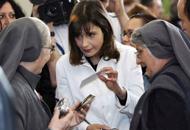 Famous Italian actress and convert, Claudia Koll, came to Medjugorje in the beginning of November on a pilgrimage. She gave interview to radio station “Mir” Medjugorje and she openly spoke about her life and her conversion. It felt as we had listened to the unwritten story of Mary Magdalene of our days. She told us about all of the troubles and difficulties she had while she was growing up, all beacuse her mom had died during her birth. She was raised by her granny and had many identity crises while she was educated and at the end got completely lost in the world of movie production.
 After a number of obscene roles in movies, Claudia walked through the Holy door on Basilica of St. Peter in Rome, in Jubilee Year of 2000 and instantly felt that the life she had up to that moment was broken and disappeared. And then, she said: “One day there was this dramatic situation that needed to be resolved and I did not know how to handle that at all. I remember being desperate, I walked the room up and down, and just simply in one moment I started to speak to God. I prayed Our Father and I was squeezing in the palms of my hands a little crucifix that one of my friends gave to me few days prior to that. In those moments, my whole being was turned towards the God, I felt as I was tied close to the Cross and I was able to feel complete liberation. I felt as I was immersed in something like a deep peace. And I rested in that feeling. No longer was I worried, nor afraid; it felt as there was only one feeling of deep silence, something unknown to me prior to that particular moment. It was that silence that spoke to me about God, I did not see Him, but I was able to feel Him. I asked Him, ´Why did You do that, why did you console me, I do not deserve that?’ Then I said: ‘You are my Father, I prayed to you in the prayer of Our Father and I told You that I would like to meet You!’ That was my prayer!”
“Lord did not take away my suffering, but He walked with me, slowly, and helped me to resolve that pain. Even more, that suffering was my journey towards Him, I started to feel desire to go back to the church. In the beginning I would just spend time in a church and enjoy silence and peace of God and that had brought me to the sacrament of Holy Eucharist. God started to heal me through the sacraments. It was a long process, with its ups and downs, but every time I would fall down, I would be getting up again.” She realised that she needs to follow Jesus and it needs to be on both of her feet, one of love and the other of truth. She would turn down all of the movie roles that were not in accordance with the spirit of Gospel. She told us interesting detail from those days: “One day I signed the contract that offered me lots of money. The role itself was not negative but I knew I shouldn’t have had signed that contract, since I was to meet those same people that I had promised to the Lord I would not meet ever again. The second I signed the contract I knew I made mistake. I was not able to say no, because I was still weak in my decisions. But, when I got the money for that project, I started to give it to the poor people in the church. I felt that money did not belong to me, it was the money of betrayal.”
The following chapter of her life was how she went to do mission work, in Ethiopia where she had witnessed so much poverty, famine, little children dying all over the place. She said: “I remember one little boy whose eyes were closed not because he was blind but because he did not have any water to wash his eyes. His eyes were inflamed because of all of the dirt that was in his eyes. I used moisture tissues to clean and wash out his eyes and while his eyes were being opened, the Lord was opening mine. I realised I lived in a luxurious home, I had expensive carpets, silver cutlery and none of that was able to save my life. I started to see everything in a different way and I realised I needed to give part of my wealth to those who were poor. “
After she came back, she visited the shrine of Divine Mercy and she was able to discover the message of Divine Mercy. “I realised that the Lord was saying to me ‘Claudia, if you fell down, that was because you trusted too much in your own abilities, trust me!’ For me, that was what ‘Jesus, I trust in you’ meant. I needed to realise that my conversion was going to happen together with Jesus and I should have trusted in my Lord more, from the beginning. I think that genuine faith is the one Abraham had, he hoped and believed beyond and against every hope and belief”, says Claudia.
Claudia also spoke about her relationship and devotion towards Our Lady. “Our Lady was always present in my life, ever since I was born. I remember watching a movie about Our Lady from Fatima, it was when I was 8, 10 years old, I do not remember exactly. And I remember saying how Our Lady was not just a statue, she was a woman. I was really impressed that Our Lady gave such important tasks to the visionaries. I remember, as I was going back home after seeing that movie, I was reciting a little prayer in my heart to Our Lady and I told her ‘I want to live with you and come to you, bring me closer to You as You brought Jacinta.’ I was asking from Our Lady to die, and Lord did not answer that prayer, but I think He wants me now to witness for Him, and all of the experiences I had are just evident proofs of Divine Mercy. “
Claudia mentioned how Our Lady was with her all along her conversion, and she feels strongly about Medjugorje and apparitions to the visionaries. In the moments of apparitions, she feels powerful presence of Our Lady. Describing one such event she said: “I could see that it was raining, but I did not feel rain drops on my umbrella at all. I think it is such a wonderful experience to feel Our Lady with heart. It never occurred to me to look for the signs, to look in the sky. I think that this encounter takes place in the depths of our hearts. I do not even want to look into the face of the visionary, I am only interested in my own prayer and encounter with Our Lady. “
Claudia emphasises especially the love she feels now through Our Lady’s presence. The love in a completely new way. The journey to that new experience had several stages. This is just one of them. “When my conversion began, first people that Lord would place in front of me were those who had AIDS. And it was through one of such young man, through his suffering that I got to know Christ’s love. I started to think about Jesus in a Garden of Gethsemane, and his sweat of blood, how he must have feared death. On the other hand, this young man was lying in a bed and he was in a very bad state. He was unable to speak because illness affected speech centre in his brain. But his eyes spoke about his fears. And when I took his hand, I felt great love in my heart. The love I never felt before, strong and gentle. It was that love that converted me. When I look into my past now, I think about how many times Jesus entered such areas of my life. But my eyes were blind, closed and I was not able to recognise Him. When my conversion started, I realised that Jesus was present in all those who were suffering.”
Claudia Koll is the founder of Association “The Works of the Father” that is dedicated to missionary work in Africa. She is building a house for disabled people called Little Lourdes. In the world of Arts, she is the Head of the Academy of Arts that was founded on the principles from the Letter to the Artists of late Holy Father John Paul II. Through this Academy, she wants to help young people to enter into the world of fame and spectacle in a healthy, Christian way. It is interesting that music from Medjugorje regularly plays inside this Academy.
Source: © Information Centre Mir Medjugorje
Subscribe to:
Posts (Atom)